Heat pump flow temperature — the most important design decision
Last reviewed: 14 May 2026
A 10°C difference in flow temperature changes your seasonal efficiency by enough to add or subtract £150-£250 from your annual running cost — and the choice is locked in at the survey. Here is what flow temperature is, what the trade-offs are, and what to verify after your install.
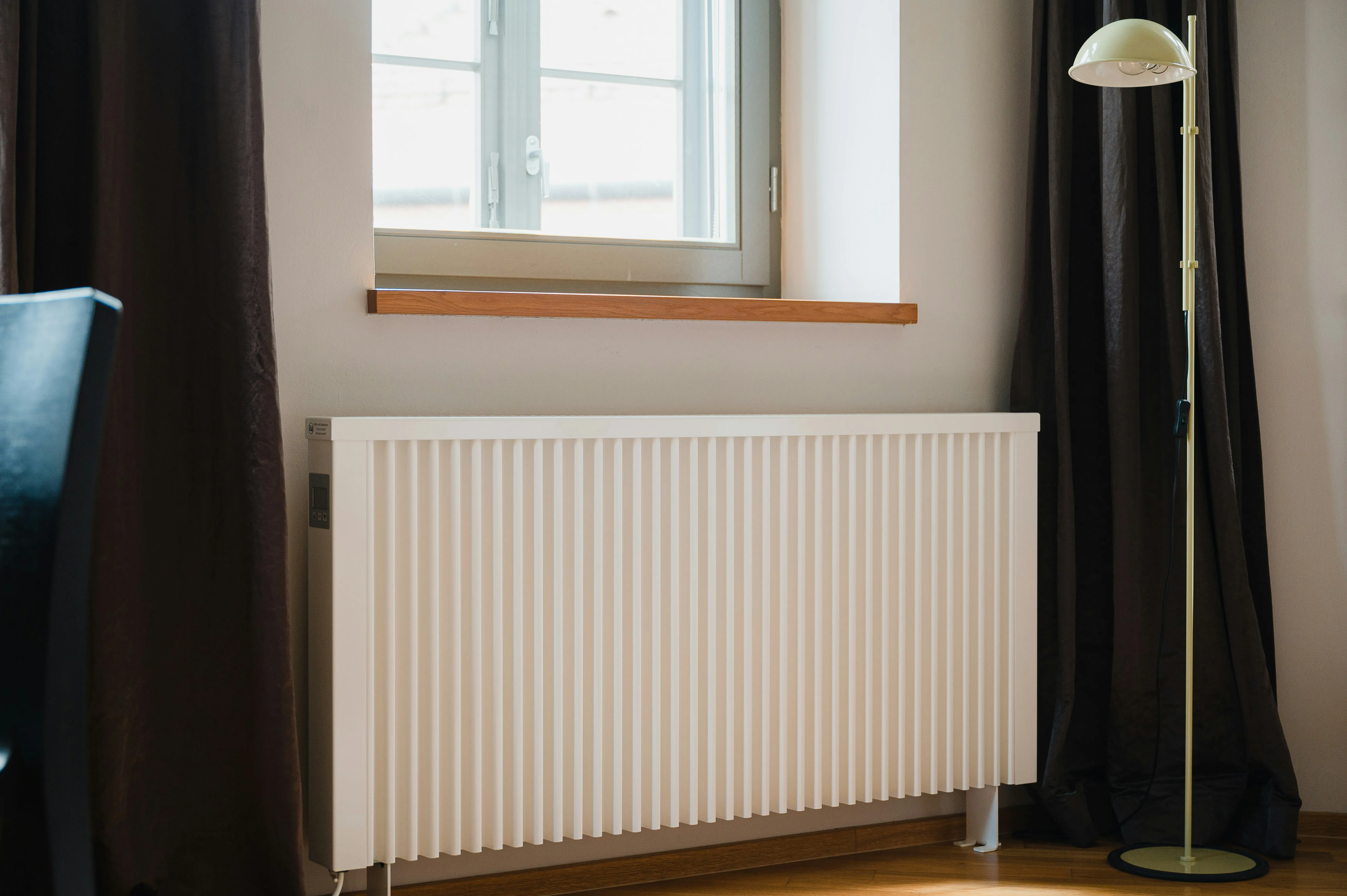
Last reviewed: 14 May 2026.
In short
Flow temperature is the temperature of the water leaving the heat pump to feed your radiators. Standard low-temperature heat pumps run between 35°C and 55°C; high-temperature units extend to 70-80°C. The flow temperature is the single most consequential design decision in a heat pump install — it dominates the seasonal efficiency (SCOP), the radiator-sizing requirement, and the install cost. Every 5°C of flow temperature you can avoid is worth roughly 0.2-0.4 SCOP, which translates to £100-£200 a year on a typical Reading retrofit — or £2,000-£4,000 across a 15-20 year asset life. Modern installs don’t run at a fixed flow temperature: weather compensation continuously adjusts it based on outdoor air temperature, achieving lower flow (and higher efficiency) in mild conditions and ramping up only when needed. Both the MCS install standard and Part L of the Building Regulations make weather compensation mandatory. The design flow temperature documented in your heat-loss survey is the maximum the system reaches, at the coldest design conditions — most operating hours sit comfortably below it.
On this page
- What flow temperature is — and why it matters
- The 35°C / 45°C / 55°C bands
- How flow temperature drives efficiency
- Weather compensation — the dynamic layer
- Where the decision is made — at the survey
- How to verify flow temperature is set correctly
- Three shortcuts to watch for
- What this means for homes in Reading
- Related guides
What flow temperature is — and why it matters
Flow temperature is the temperature of the water leaving the heat pump on the supply side of your heating system. The return temperature is the water coming back to the heat pump after passing through your radiators. The average — the mean radiator temperature — is what determines how much heat each radiator delivers into each room.
A gas boiler runs at around 70°C flow with maybe a 10°C drop across the radiators, giving a mean radiator temperature of 65°C in a 20°C room. The temperature difference driving heat output is 45°C.
A heat pump running at 50°C flow with a 5°C drop gives a mean radiator temperature of 47.5°C in the same 20°C room. The temperature difference is now 27.5°C — much lower.
Three things follow from the smaller heat-pump temperature difference:
- Radiators deliver much less heat at the same dimensions. Our radiator sizing guide covers the arithmetic in detail.
- The heat pump runs more efficiently. The compressor does less work because the temperature gap from outdoor air to flow water is smaller.
- Hot water needs separate handling — it has to reach at least 50°C in the cylinder (and ideally 60°C periodically for legionella protection), so the heat pump cycles into a higher-flow mode for DHW production, then returns to lower flow for space heating.
The 35°C / 45°C / 55°C bands
Standard low-temperature heat pumps work in three practical flow-temperature bands:
35°C flow. The underfloor-heating territory. Real-world seasonal efficiency commonly 4.0-4.5. Achievable in new-build, comprehensive retrofits with underfloor heating throughout, or excellent-fabric properties with substantially oversized radiators. Uncommon as a retrofit target because it usually needs either underfloor heating or radiators roughly 2.5× the gas-boiler-era size.
45°C flow. The design sweet spot for most modern UK retrofits. Real-world seasonal efficiency commonly 3.7-4.1. Workable in cavity-walled properties with modest radiator upgrades (typically 2-4 radiators in a 3-bed), in well-insulated solid-wall properties, and across most of the Reading suburban semi belt — Tilehurst, Earley, Whitley, Lower Earley modern estates. This is where the radiator-upgrade cost is reasonable and the efficiency is materially better than 55°C.
55°C flow. The “minimal radiator changes” band. Real-world seasonal efficiency commonly 3.0-3.5. Relevant when wall space genuinely cannot accommodate larger radiators (deep skirting, panel walls, listed-property constraints), when microbore pipework prevents the higher flow rates that lower flow temperatures need, or when capital budget makes radiator upgrades impossible at install time.
The efficiency penalty at 55°C is real and persistent. Over a 15-year asset life — at a typical Reading 15,000 kWh annual heat demand and 27p/kWh electricity — the difference between 45°C SCOP 3.9 and 55°C SCOP 3.3 is roughly £400 a year × 15 years = £6,000 more electricity over the life of the install. That framing is important: a £2,500 radiator upgrade to drop from 55°C to 45°C pays back in around 6 years, then keeps paying for the next 10-15.
Above 55°C — high-temperature heat pumps. A separate category, typically R290 (propane) refrigerant, going up to 70-80°C flow. Seasonal efficiency in this band drops to 2.5-3.0 — but radiator and pipework retrofits are typically not needed. Useful where emitter changes are blocked (listed-building consent, microbore pipework, minimum-disruption retrofits). The category is growing in 2026 as R290 units broaden in availability. The trade-off (SCOP 2.5-3.0 vs SCOP 3.7-4.0) is yours to make once the survey lays out the options.
How flow temperature drives efficiency
The mechanism: the compressor’s electrical input scales with the temperature lift from outdoor air (the heat source) to flow water (the heat sink). Pulling heat from +5°C outdoor air to deliver to 35°C flow is a 30°C lift. Doing the same to deliver to 55°C flow is a 50°C lift. Higher lift = more compressor work = lower efficiency.
The rule of thumb cited consistently across installer sources: every 5°C of flow temperature increase costs roughly 5-10% efficiency. The exact figure depends on the unit and the outdoor temperature, but the directional relationship is solid.
This is why the survey’s flow-temperature decision is so consequential. A design that defaults to 55°C “to avoid radiator upgrades” locks in a 0.5-0.8 lower SCOP for the life of the system. The penalty is invisible at install time — the heat pump works, the home is warm, there is no comparison point. But it shows up reliably in the electricity bill every winter, and it compounds for 15-20 years.
Our SCOP, COP and HSPF explainer covers the efficiency metrics in detail.
Weather compensation — the dynamic layer
Modern heat pump installs don’t run at a fixed flow temperature. Weather compensation continuously adjusts the flow temperature based on outdoor air temperature, achieving lower flow temperatures (and higher efficiency) in mild conditions.
How it works. An outdoor temperature sensor mounted on a north-facing exterior wall feeds outdoor temperature data to the heat pump’s controller. The controller looks up a pre-configured heating curve — also called a weather compensation curve or “heat curve” — that maps outdoor temperature to target flow temperature.
A typical Reading-area retrofit at a 45°C design flow temperature might run something like this:
| Outdoor temperature | Target flow temperature |
|---|---|
| +15°C (early autumn / late spring) | ~28°C |
| +10°C (mild heating-season day) | ~33°C |
| +5°C (typical winter day) | ~39°C |
| 0°C (cold winter day) | ~44°C |
| −3°C (design conditions) | ~46°C |
The design flow temperature (here 45-46°C) is the maximum the system reaches, only at the coldest design conditions. Most heating-season hours run materially below it — and at higher efficiency.
This is why real-world fleet data from well-designed UK installs commonly shows seasonal performance better than the declared SCOP at the design flow temperature. The unit spends most of its hours below the design point.
Tuning the curve. The factory-default curve is a starting point; it should be tuned at commissioning and again after one full heating season:
- If the home is too warm in mild weather, the curve is too steep at high outdoor temperatures — reduce.
- If the home is too cool in the coldest weather, the curve is too shallow at the cold end — increase the design flow temperature.
- If the home is comfortable but rooms balance unevenly, the issue is radiator sizing, not the curve.
A good installer revisits the curve after the first heating season. A great installer monitors the in-service efficiency and tunes to maximise it without sacrificing comfort.
MCS and Part L compliance. Both the MCS install standard (MIS 3005-I V3.0, current from December 2025) and Part L of the UK Building Regulations make weather compensation mandatory for heat pump installations. A heat pump install without a weather compensation curve in place is not MCS-compliant and would fail an Ofgem BUS audit. If your installer hasn’t set up weather compensation at handover, ask why — it’s required, not optional.
Where the decision is made — at the survey
The design flow temperature is decided at the heat-loss survey stage (covered in our heat loss survey guide) based on the room-by-room heat-loss outputs combined with your existing radiator schedule. The process:
- Calculate room-by-room heat losses at design external conditions (−3.0°C for Reading).
- Inventory existing radiators with their nominal outputs.
- For each room, calculate the maximum flow temperature at which the existing radiator can meet the room’s heat loss.
- Identify the rooms where the existing radiator is the binding constraint — these set the system’s maximum flow temperature.
- If the resulting flow temperature is uncomfortably high, flag radiator upgrades in the binding rooms; recalculate.
- Settle on the lowest flow temperature that all rooms can meet with the radiator schedule (existing + upgrades).
The output: a design flow temperature, a radiator schedule, and a clear cost-vs-efficiency picture. You see the trade-off — radiator upgrade cost now vs running-cost saving for the next 15-20 years — and make the call.
How to verify flow temperature is set correctly
Post-install verification:
At commissioning. Confirm weather compensation is enabled. Check the unit’s controller settings. The maximum flow temperature at the cold end of the curve should match the design figure from your heat-loss survey.
First week of operation. Note actual flow temperatures during normal use. On a mild day (+5 to +10°C outside), flow temperature should be running in the 35-42°C range, not at 55°C. If the unit is sitting at maximum flow regardless of outdoor temperature, weather compensation isn’t working.
End of the first heating season. Review actual seasonal performance if your unit reports it (most modern ones do via app). Compare against the design SCOP. A material gap (more than 0.3 below design) suggests something is off — the curve, the radiator balancing, or the schedule.
End of the second year. Curve refinement based on two seasons of data. Tune toward lower flow temperatures where comfort allows; tune up where it doesn’t.
A good installer offers a curve-tuning visit at the end of the first season as part of the install package or at modest cost. If yours doesn’t offer this, that’s worth flagging at the contracting stage.
Three shortcuts to watch for
Three patterns that signal an under-designed install:
Default 55°C flow temperature without justification. The most common installer shortcut. The specification is set to 55°C to avoid radiator changes, the heat pump works, the homeowner doesn’t notice the SCOP penalty until the first year’s electricity bill arrives. The 55°C choice should be documented with a reason — listed-property constraints, microbore pipework — not silent defaulting. Ask explicitly: “Why isn’t this designed for 45°C flow with radiator upgrades?”
Weather compensation disabled or set to a flat curve. A flat curve (constant flow temperature regardless of outdoor) defeats the entire point of weather compensation. This is sometimes done at commissioning by installers who don’t want callbacks for curve-tuning, but it sacrifices a meaningful share of the seasonal efficiency. Both MCS and Part L require weather compensation to be active.
Curve set to factory default and never tuned. Factory defaults are conservative — they assume worst-case radiator sizing and tend to over-flow in mild weather. A proper install tunes the curve to the specific property after at least one full heating season.
If any of these patterns appears in your install, the conversation to have is concrete: ask for the design flow temperature documented in the survey, the curve currently programmed, and the rationale. A reputable installer won’t flinch.
What this means for homes in Reading
Reading’s −3.0°C design external temperature is mild relative to most of the UK, which gives a slight tailwind to lower-flow-temperature designs:
Central Reading and lower Caversham — Victorian and Edwardian terraces. High-heat-loss fabric pushes flow temperatures up unless internal-wall insulation is feasible. Practically achievable: 50-55°C in unimproved properties; 45-50°C with insulation and 3-4 radiator upgrades. SCOP outcomes typically 3.0-3.5 unimproved; 3.5-3.9 improved.
Tilehurst, Earley, Whitley, Woodley — inter-war and post-war semis. Cavity-walled, modest fabric losses. 45°C flow comfortably achievable with 2-3 radiator upgrades. SCOP outcomes typically 3.6-4.0.
Lower Earley, Woodley, modern estates. Modern fabric, low heat losses. 40-45°C flow common with 1-2 radiator upgrades (or none). SCOP outcomes typically 4.0-4.4 — the best Reading-area band.
Caversham Heights, Caversham Park, listed properties. Radiator changes constrained by consent. High-temperature heat pumps (70°C flow) become a realistic option — SCOP penalty acknowledged but the retrofit complexity is minimised. SCOP outcomes typically 2.5-3.0 in high-temp configuration; 3.5+ with full retrofit and consent.
The pattern across Reading: modern-estate installs deliver the highest real-world efficiency, conservation-area installs the lowest, the suburban semi belt in between. The flow-temperature decision sits at the heart of which band the install lands in — and the survey is where it’s made.
Related guides
- Heat loss surveys for heat pumps — what they are, what to expect — the design exercise where flow temperature is decided
- Do you need bigger radiators for a heat pump? — the emitter consequence of the flow-temperature choice
- SCOP, COP and HSPF explained — the efficiency consequence of the flow-temperature choice
- Heat pump running cost in the UK 2026 — where flow temperature shows up in your annual bills
Want to know what design flow temperature your Reading property can realistically run? Our MCS-certified team designs every install at the lowest workable flow temperature for the property — with the radiator changes that get the seasonal efficiency into the 3.7-4.2 band — and tunes the weather compensation curve at commissioning and again after the first heating season.
Get a quote | Call us on 0118 [number] | Email [address]
See what a heat pump would look like in your Reading home
The mechanism is the same in every UK home; the design is specific to yours. Our team carries out a free in-home survey including a full room-by-room heat-loss calculation, identifies the system size and configuration that fits your property, and provides a written quote with the £7,500 BUS grant already deducted.
You'll see the actual figure you'd pay — not an estimate — and the projected efficiency for your specific install.